Your role as a Department Leader involves many new responsibilities and building new relationships across the College. This position comes with challenges and opportunities to grow and will certainly never be boring.
Please see the newest Department Leader Handbook (2024) which provides helpful orientation info.
The Instructional Associates (IAs) at CTLR are here to help you navigate the transition, and assist with some key areas of your job: mentorship/connecting with other department leaders, developing a department online/blended learning strategy, annual program reviews, program renewal, hiring and orienting new faculty, developing instructor teaching skills, and curriculum development and revision.
Three key transitions for new department leaders described by John Bennet (cited in Hecht, et. al) are:
- From specialist to generalist – needing to understand the full department outside your area of expertise;
- From working individually to running a collective – balancing responsibility for carrying out department objectives with respect for faculty autonomy, managing staff;
- Balancing more perspectives – understanding and responding to department views/needs as well as institutional perspectives.
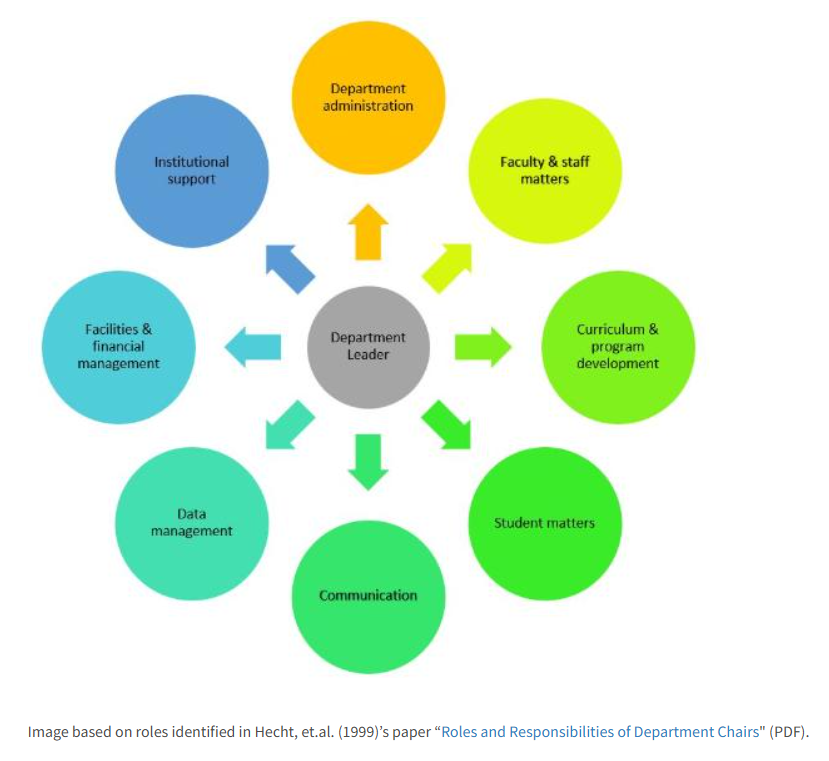
Irene W. D. Hecht, Mary Lou Higgerson, Walter H . Gmelch, Allan Tucker. “Roles and Responsibilities of Department Chairs.” The Department Chair as Academic Leader (Phoenix, AZ: ACE Oryx Press, 1999). Chapter 2. Retrieved from http://college.emory.edu/faculty/documents/articles/power-of-department-chair.pdf.
The framework below for a department leader’s responsibilities falling into 8 core areas can be useful for both understanding and being effective in your role.
- VCC People Services’ opportunities for Leadership Development
- Heads and Chairs from University of Manitoba provides you with foundational knowledge and skills to develop and enhance your academic leadership at the departmental level. Led by a team of experienced academic administrators, it draws upon both the literature and practice of academic leadership and presents it to you in a highly interactive setting.
- Surviving and (sometimes) Thriving as Department Head
- Camosun’s Resources for Chairs: Engaging with Faculty and Staff
- Decolonizing leadership (3 recorded webinars, 1.25 hrs each)
- Reflective Practice in Higher Education (PDF)
Instructional Associates (IAs) chair the hiring committee for any new permanent faculty.
At the department leader’s request, IAs may chair or mentor the department leader in hiring auxiliary/term faculty following the Collective Agreement. See the department leader handbook for more information
Equitable hiring is the practice of creating fair and inclusive hiring processes. Equitable hiring removes barriers, provides accommodations, and ensures all candidates, including those from marginalized groups, have an equal opportunity to compete for a role. Equitable Faculty Hiring at Vancouver Community College (S. Ivits, 2025).
In your role as department leader, there is an opportunity to review hiring practices including interview questions and interview structure, and consider how to create inclusive hiring processes to find the best candidates. The Equitable Faculty Hiring at Vancouver Community College guide is an excellent supplementary resource to support this work. You can also reach out to the Instructional Associates for support.
Note for People Services assists with Support Staff hiring and provides guides for all hiring, including emergency recruitment.