Student assessment is a critical aspect of the teaching and learning process. Assessment of learning can be either formative or summative. Formative assessments happen throughout the learning and give students and instructors valuable feedback about the learning that is taking place. Formative assessments can be graded or ungraded. Summative assessments allow instructors to determine overall student performance. Both types of assessment used together, in alignment with the learning objectives, will best support student outcomes. CTLR can assist you in designing an assessment plan for your class including formative and summative assessments, alternative and authentic assessments, and UDL principles.
The role of assessment planning is crucial to teaching and learning. Paraphrasing from Higher Education Academy – Transforming Assessment in Higher Education: A Case Study (Elkington, S., & Evans, C. (2017)):
Assessment shapes what students study, when they study, how much work they do and what approach they take to their learning. Assessment results impacts how students view themselves and may provide satisfaction or discouragement. The intentionality of assessment planning and design is influential in determining the quality and amount of learning and if we wish to improve student learning, improving assessment should be our starting point
There are generally three purposes to assessment planning and design that enables use to rethink classroom assessment with purpose and intentionality in mind: Assessment for, as, and of learning. The order (for, as, and of) is intentional, indicating the importance of assessment for and as learning in enhancing student learning formatively, and reserving of learning for when it is necessary to make summative decisions.
- Make student understanding visible.
- Use this type of assessment to find out what their students know and can do, and misunderstandings/gaps. Instructors can adjust feedback, strategies, activities as needed.
- Formative, can be low-stakes, non-graded. Scaffold these formative assessments to lead students to the major assessments of learning that are summative.
- Happens throughout the learning process.
- How to: Focused observations, think-pair share, conversations, Kahoot quizzes, learning logs, reflective journals, CATs (e.g. Muddiest Point).
- Try to incorporate UDL (e.g., verbal, written, visual, presentation-based, etc.).
- Good place to provide descriptive feedback for learning.
- Students actively engage in creating their own understanding. They do so by being active monitors of what they are learning. They make sense of information, relate it to prior knowledge and use it for new learning (meta-cognition = learning how to learn).
- Students adjust, adapt or change in their thinking.
- Instructors model and teach the skills of self-assessment, guide students in setting and monitoring goals, help students develop clear criteria for good practice with internal feedback skills, and create an environment where students can make changes and where support is provided
- Any method that can encourage reflection and review, along with relation to models, criteria, rubrics, checklists that provide images of successful learning.
- Good place to collaborate with students to drive the assessment method
- Summative. Typically at end of unit or course.
- Students demonstrate whether they have met curriculum outcomes or competencies.
- Effective assessment of learning considerations:
- At the right place at the right time.
- Clear descriptions provided of assessment criteria and processes.
- Must align with the learning outcome.
- Fair and unbiased. Appropriate difficulty. Appropriate weighting.
- Methods: Tests, exams, portfolios, exhibitions, performances, presentations, simulations, multimedia projects, other written, oral or visual methods, hands-on demonstration, authentic.
The typical steps for planning and designing assessments involve:
- Reviewing your course learning outcomes.
- Choosing and designing your assessments for alignment to learning outcomes and for balance in assessment types and tools.
- Developing criteria and rubrics.
- Adjusting for delivery method and how you want to deliver feedback.
Here is an example of a sample assessment plan template. Consider:
- Are the assessments aligned with the learning outcomes and objectives? (and is this clear to students?)
- Are there rubrics to give student a clear understanding of expectation of work and provide meaningful feedback?
- Is there a balance (high-stake and low-stake) and variety of assessments across the learning outcomes?
- Are the assessments fair and transparent?
- Does the distribution of time and effort (yours and the students) reflect the importance of the outcomes and assigned weights?
- How does delivery mode impact the assessment you’re choosing?
For more help with designing student assessments, consider taking this online learning module from the University of Calgary where you will learn how to design effective student assessments aligned with learning outcomes, explore different assessment strategies, and apply techniques to enhance student learning and academic integrity.
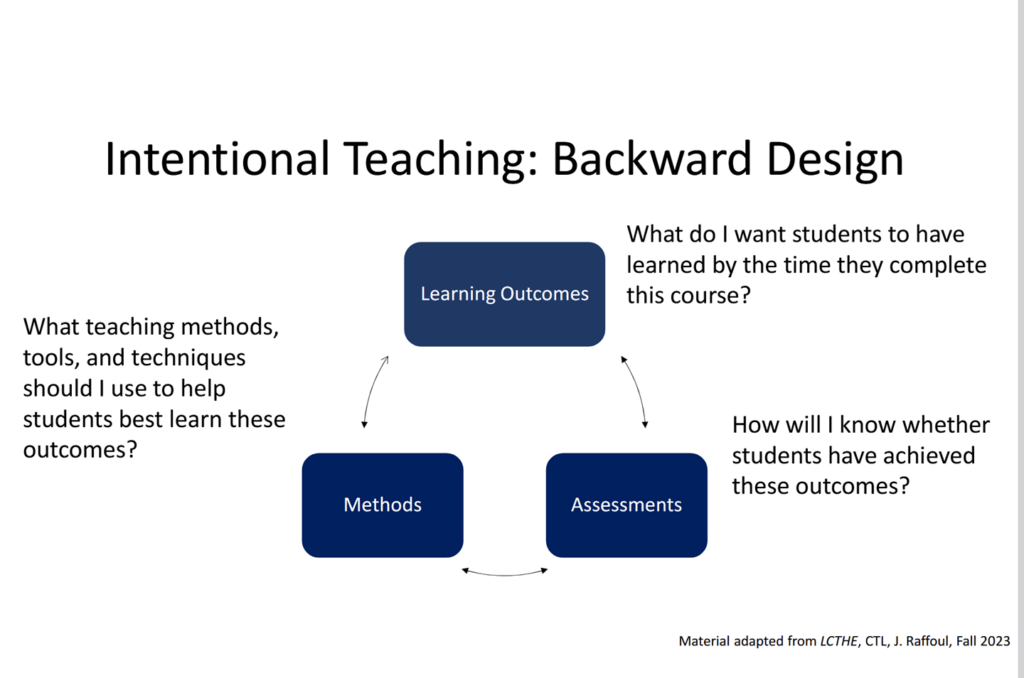
Assessment should align with course learning outcomes and is a key component of Course Planning.
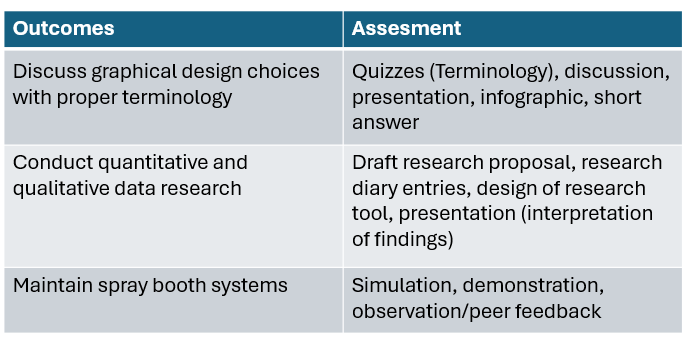
Here is an example of learning outcomes aligning with assessment types:
Alternative assessments offer ways for students to demonstrate deeper learning by applying knowledge rather than simply recalling facts. Unlike traditional exams, these assessments emphasize real‑world tasks, problem‑solving, reflection, and the ability to do something meaningful with what they’ve learned. They can motivate learners, support diverse learning needs, and provide a more accurate picture of student understanding and skill development.
Examples of Traditional vs. Alternative Assessments
| Traditional Assessment | Alternative Assessment | What makes it Authentic |
| Multiple-choice or short-answer test | Case study analysis | Requires students to apply course concepts to realistic scenarios, mirroring decision‑making in professional contexts. |
| Midterm or final exam | Portfolio of work | Demonstrates growth, reflection, and real‑world skill development over time rather than isolated recall. |
| In-class essay exam | Project or poster presentation | Engages students in communicating ideas to an audience—an essential workplace skill—using authentic formats. |
| Instructor‑graded written assignment | Peer or self‑assessment | Mirrors professional practices of review, feedback, and self‑evaluation, promoting metacognition and collaboration. |
| Skill‑recall quiz | Performance or demonstration | Shows what students can do with their knowledge, emphasizing applied proficiency and practical execution. |
For more examples and information, explore Best Practices in Alternative Assessments – Toronto Metropolitan University.
A rubric is a structured assessment tool that lays out what you want students to learn and how their work will be evaluated. It includes the criteria that you are assessing and clear descriptions of what different levels of performance look like. Rubrics come in two main types: analytic rubrics, which break an assignment into separate parts (like organization, accuracy, or use of evidence), and holistic rubrics, which give one overall score based on the quality of the work as a whole.
Rubrics can make grading more consistent and transparent, help students understand what’s expected, and save time once they’re set up. At the same time, developing a good rubric takes some thoughtful planning—especially when writing clear, specific performance descriptions and avoiding vague language. But once created, rubrics become valuable guides for both teaching and learning.
For an overview and examples of rubric types, here is a slide deck from one of our CTLR workshops. Reach out to iasupport@vcc.ca for support in developing rubrics.
Feedback is most effective when it is ongoing and built into the flow of a course. When students receive regular information about how their learning is developing, they are better able to understand what they are doing well and where they may need additional practice or support. This helps reduce anxiety, builds confidence, and keeps learning moving forward.
Using both formative (during learning) and summative (after learning) feedback gives students a more complete understanding of their progress. Formative feedback guides improvement in real time, while summative feedback helps students reflect on their overall achievement. A range of feedback approaches can make the process more flexible and meaningful:
- Peer feedback, when scaffolded with simple instructions or models, helps students learn how to give and receive constructive comments while developing assessment literacy.
- Descriptive instructor feedback—whether delivered verbally, in writing, by video, online, or in person—gives students clear, actionable information that can be used to make improvements.
- Group or class feedback on quizzes or exams can highlight common errors or areas that need further explanation, reducing repeated confusion and allowing students to learn from shared experiences.
Effective and constructive feedback that reinforce skill-development and learning over time, focus on the work, the strategies used, and the next steps, rather than on personal traits or fixed ability. This approach supports student learning without overstepping into judgment or reassurance that may feel unhelpful. Here are a few practices that can help keep feedback encouraging and forward-looking:
- Focus on specific observations. Highlight concrete elements of the student’s work—what is effective, where clarity could be strengthened, or how an approach might be refined. This keeps feedback actionable and grounded in what the student produced.
- Name progress and learning strategies. When relevant, point out where a student’s effort, process, or decision‑making contributed to their outcome. This draws attention to the strategies that support learning rather than suggesting ability is fixed.
- Offer next steps. Students often benefit from knowing what they can try next—such as revising an argument, practicing a particular skill, or using a different method to approach a task. Clear, achievable next steps help create momentum.
- Keep language neutral and respectful. Feedback framed around improvement (“Consider strengthening…”) rather than evaluation of the person (“You are…” or “You’re not…”) helps maintain a supportive tone and avoids discouragement.
- Avoid overpraising or vague encouragement. Generic statements like “Good job!” or “Keep trying!” offer little guidance. Instead, aim for feedback that helps students understand why something is effective and how they can build on it.
For more resources, explore:
- University of Waterloo’s Receiving and Giving Feedback
- George Brown College’s Giving Students Feedback