Inclusive teaching refers to intentional approaches in your teaching practice where:
- all students experience welcome and belonging
- all students can engage with content and demonstrate learning in ways that respect their identities and abilities
- all students are supported to learn to their full potential
Our classrooms reflect the full range of human diversities, many of which are hidden to us. Inclusive teaching practices help to create an environment where students who otherwise experience exclusion or marginalization can also thrive.
The following five principles are adapted from Summary of Principles of Inclusive Teaching and Learning (McMaster University) and Guide to Inclusive Teaching (Columbia University).
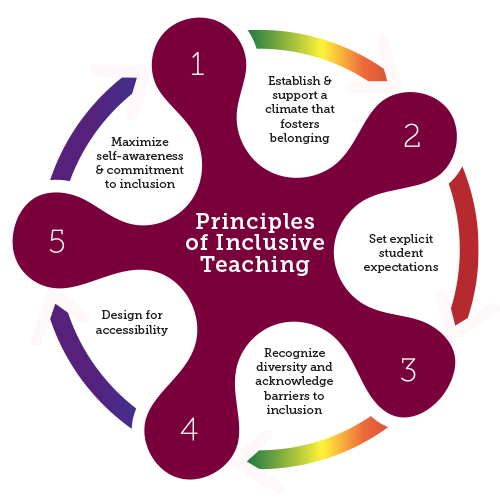
Set up your course so students feel seen, respected, and valued, regardless of their identity, background, or abilities. Some strategies:
- Use inclusive language and respectful communication.
- Be curious but non-intrusive – learn about student experiences, motivations, passions.
- Value student lived experience and knowledge.
- Never ask a student to speak as a representative for their social group.
- Start with ice-breaker activities and encourage small group work to build connections.
- Invite students to fill out an index card (in class or online) with their name, pronouns, reasons for taking the course, and interests.
- When tricky issues comes up, refer to the ideas – not the individuals (e.g. “We noticed in the readings …”).
- At various points throughout the course, solicit feedback from students on their learning experience, your teaching, and the classroom climate. Be clear about what you can and cannot change from their feedback. An Instructional Associate from the CTLR can facilitate a feedback session with your students.
Be clear about what success looks like. Some strategies:
- Use clear language in your syllabus for course expectations.
- Codevelop classroom agreements around class behaviour.
- Share same level of confidence and high expectations for all students.
- Be transparent about learning outcomes, assessments.
- Provide rubrics and walk students through how they work; let them try grading a sample.
- Share exemplars of student work (make sure you get consent from previous students and remove any identification).
- Ensure your syllabus include all relevant institutional policies.
Choose content that reflects diverse perspectives. Some strategies:
- Include diverse representation in course materials – think about whose perspectives/voices are missing.
- Invite guest speakers with varied backgrounds and experience.
- Create examples and case studies that reflect diversity/challenge stereotypes.
- Use a variety of active learning, individual vs group activities. Allow choice
Plan your course so that students with diverse learning needs can learn effectively. Use a Universal Design for Learning (UDL) approach. Some strategies:
- Provide captions for videos, written notes to complement oral information, transcripts for audio, alt text for images, vocabulary /symbol lists, accessible slides (aspects of Universal Design for Learning).
- Avoid scanned copies. Make sure they are appropriate OCRd (Optical Character Recognition).
- Provide scaffolding for large assignments.
- Chunk large units of content.
- Consider accessibility in any software chosen. Consider costs.
- Include a statement in your syllabus about disabilities and accommodations. See VCC Accessible Syllabus Template for sample statements.
Teaching choices and assumptions come from your own background and sometimes hidden biases. Reflecting on these can help you to teach more fairly and effectively. Some strategies:
- Think about your own values and how they shape expectations of students.
- Reflect on implicit/unconscious biases – consider how your own culturally-bound assumptions may influence your approach to teaching; interactions with students, course materials, and your discipline.
- Use moments of stereotyping in class as opportunities to challenge assumptions.
- Use critical self-reflection to adapt and improve teaching practice (Reflect on feedback from students and peers).
Inclusive Teaching Resources:
The following learning modules offer strategies to incorporate inclusive teaching practices into your teaching.
- Culturally Responsive Pedagogy Fundamentals (McMaster University)
- Trauma Informed Pedagogy: The Fundamentals (McMaster University)
- Learning Module: Anti-Racism, EDI and Positionality in Teaching and Learning (University of Calgary)
- Teaching Positionality Statements (Queen’s University)